Is Inflation Higher Than We Think?
What the official inflation data misses about rising costs.

I recently saw this tweet from Pieter Levels arguing that inflation is actually much higher than people think because of decreasing product quality (and not just increasing prices):
I think we’re 100% in some kind of hyperinflationary state
But the hyperinflation is hidden from prices and instead shows up in the extreme decrease in quality of almost every product and service
We’re in an asset boom where stock prices look like they’re growing but they just show the underlying value or currencies is rapidly dropping
That’s why the same product or service you bought 2 years ago is now twice the price but more than half the quality, so essentially became 4x more expensive
You can’t measure this inflation easily because quality is subjectively perceived and not included in inflation data (how would you?) but it’s happening for sure
I wouldn’t go as far to say we are in a “hyperinflationary” state, but I see his point. Last year I wrote about the death of the Amex lounge and how the explosion in Level 4 ($1M-$10M) wealth has led to reduced quality across many traditional “upper middle class” services.
One area where I’ve seen this is the restaurant industry. I remember going to one of my favorite steakhouses and ordering a ribeye and was delighted to see the price hadn’t gone up. But when my steak came out I was shocked—it was by far the smallest ribeye I’ve ever been served. I looked down at the plate and couldn’t believe it. What is this? A ribeye for ants? I didn’t complain but haven’t been back since.
My wife had a similar experience at one of those all-you-can-eat Brazilian steakhouses. After sampling a few of the meats making their rounds, she asked for ribeye (her favorite). They told her it was “cooking” and when it finally came out 45 minutes later, there was one round of it and then it never came back. Over the course of her 2 hour dinner she got one slice of ribeye. So much for all-you-can-eat, but hey, at least the price didn’t increase, right?
While both of these examples are anecdotal, they illustrate a more pernicious form of inflation—reduced size or quality. Technically, the BLS does adjust for shrinkflation, or when the size of a product decreases even as the price stays the same. You may have noticed this with shrinking candy bars and paper products over the last few years.
But the BLS doesn’t adjust for what’s being called skimpflation, or when a business skimps on the quality of their product or service while keeping the price the same. If you’re a big consumer of chocolate bars, you’ve probably noticed a difference in taste recently as manufacturers swapped out cocoa for cheaper alternatives. The same thing happened with salad dressing as some producers reduced the amount of oil in their product to save money.
The reduction in service quality may be even worse than the reduction in product quality though. The American Consumer Satisfaction Index (ACSI) Restaurant and Food Delivery 2025 study found that customer ratings dropped across every category for full-service restaurants from 2024 to 2025:
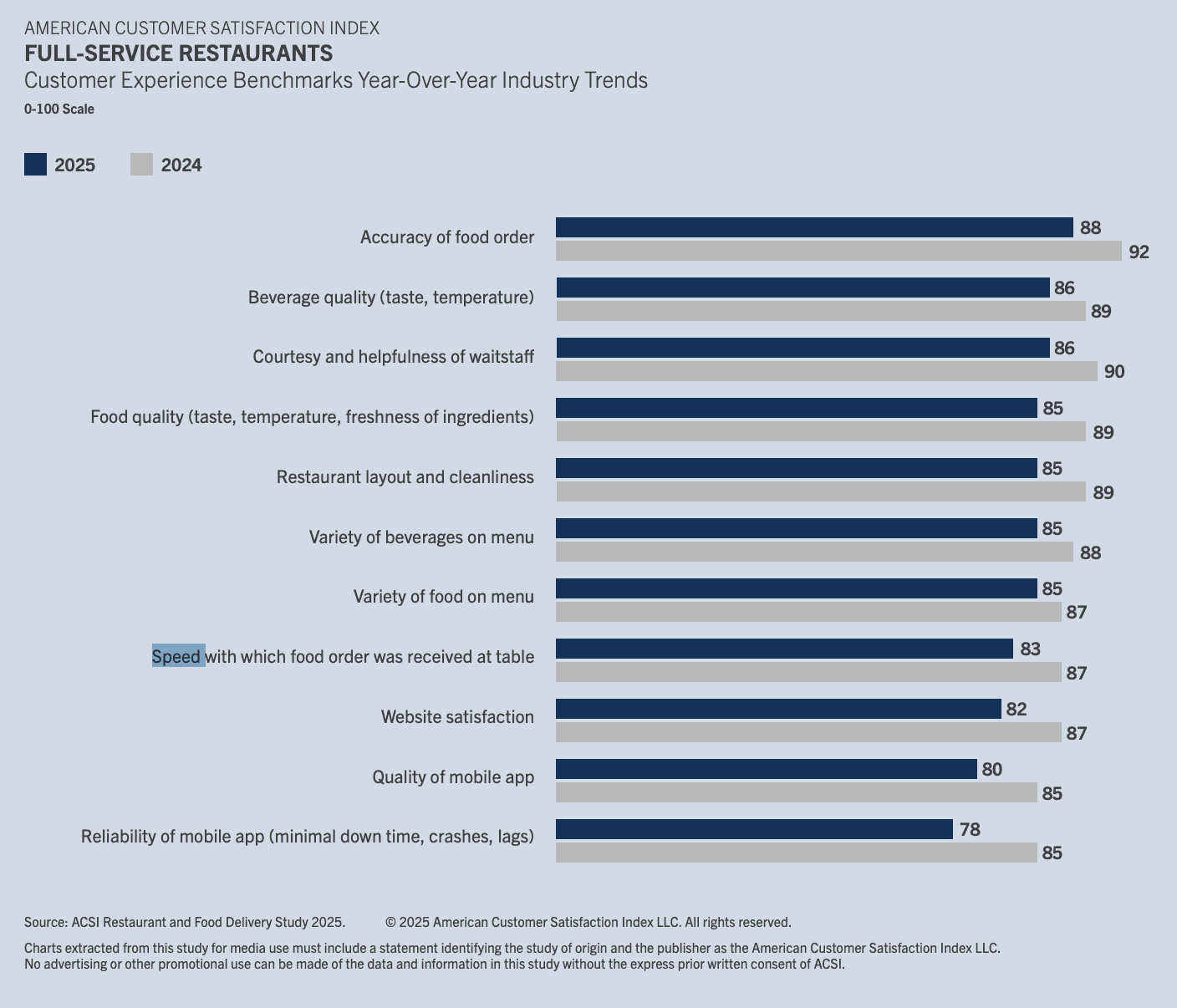
This 5% average drop in service quality (across all categories) occurred even as restaurant prices increased by about 5% in 2025. While a drop in service quality isn’t the same as an increase in price, the end result is—you get less for your money. As a result, you can see how the true inflation rate in 2025 is higher than what’s officially reported.
Why does skimpflation exist? Because it’s easier to conceal reduced quality than higher prices. When a restaurant increases their prices, regulars notice immediately. But when they lay off a busboy and the food takes a few minutes longer to come out, it’s not immediately obvious.
What makes skimpflation even worse is that it’s not tracked in the official data. When a company replaces their customer service team with AI chatbots, the price of the service is unchanged. But now you have to spend 10 minutes fighting with a chatbot instead of 1 minute with a human who can solve your problem. Your price is the same but your cost is higher.
While shrinkflation was found to be a negligible part of overall inflation, skimpflation may not be. My guess is that skimpflation could be 5% per year at worst in some industries. What is it across the entire economy? I don’t know, but let’s assume it’s half as bad, so 2%-3% per year. That takes the experienced inflation rate closer to 5%-6%. That’s nowhere near hyperinflation, but it’s a bit higher than what’s being reported (~3%).
I don’t think this is some grand conspiracy either, just rational economic actors responding to market forces. Consumers are tired of price increases over the last few years and companies know this. So their best option is some shrinkflation or skimpflation rather than raising prices further.
Is skimpflation proof of widespread dollar debasement? Not necessarily. Yes, the U.S. dollar is losing value. That’s not up for debate. But, it’s always losing value. The only time it didn’t lose value in the last century was during The Great Depression. And who wants to go back to that?
I think the real issue is that we’ve grown accustomed to 2% inflation over the past few decades. So when inflation comes in higher than that, some people get carried away and assume the dollar is hyperinflating. From 1913 to 2025, USD inflation averaged a little over 3% per year. We are slightly above that now (if you include skimpflation). But to jump from a 5%-6% inflation rate to hyperinflation is a stretch.
Don’t get me wrong, too much inflation is a bad thing. It’s not good for consumers or markets. No one likes the instability. But there’s a big difference between elevated inflation and hyperinflation. I just hope that none of us ever realize it first hand.
Thank you for reading.
This post was originally published at: https://ofdollarsanddata.com/is-inflation-higher-than-we-think/
Great read!
The food service industry added more employees in ‘25 than in ‘24 (200k vs. 130k). Teens and young people make up a large portion of that workforce.
I wonder if the decline in quality is just from inexperience and if it will moderate over time as those young people gain experience.
This is a good read for me to share with my financial analyst/wall street friends who keep telling me what I see and feel is wrong, inflation has been coming down and it is at 2%