The Great Filter
On the birth of my first child and how much has to go right for a life to begin.

It’s 1:30 AM and my wife is in the middle of labor. We’re both trying to get some sleep while she dilates further from 3cm to the ultimate goal—10cm. That’s when I wake to one of the nurses telling my wife:
We don’t want you to panic, but you’re about to hear a loud noise and then a lot of people are going to come into the room.
Before I can turn my body to see what’s going on, an alarm rings out. Within seconds, half the hospital staff seem to have spawned into our delivery room.
The heart rate’s dropping.
Change her position.
My wife, who was previously on her back, is now doing a cat pose as 20 eager faces stare at the monitors plotting our baby’s heart rate.
I know what’s happening, or at least I think I do. Based on the handful of baby books I’ve read over the past few months, it seems like our baby’s heart rate has fallen too low and the doctors are trying to raise it. If they can’t, they’ll need to perform an emergency C-section.
That’s when I hear:
Wait. It’s rising.
A few moments pass as a slow calm takes over the room. One of the physicians walks over to examine my wife:
She’s 9cm.
The room erupts with cheers. A moment of panic quickly turns into a moment of joy. Less than three hours later, my wife would give birth to our daughter.
Since becoming a parent a few weeks ago, I’ve thought about this moment a lot. I’ve thought about it because it demonstrates how fragile life can be. Change a few conditions ever so slightly and my wife and I could’ve had a very different outcome in that delivery room. I’m thankful we didn’t.
Over the last nine months there have been many moments like this where something could’ve gone wrong. Moments where we were worried about one thing or another.
Our pregnancy started with our baby not having a heartbeat at her first ultrasound. We didn’t know it at the time, but we were simply looking too early. But even after the heartbeat came a few weeks later, the worries didn’t end. We were concerned about genetic risks, down syndrome, our baby’s organ development, my wife’s glucose test, the baby’s body position, and much more.
While the probability of any one of these going wrong is small, taken together the chance of some complication is larger than you realize. And I say this as someone whose wife had as about as positive a pregnancy as you can have. We had no issues getting pregnant, no morning sickness, and no serious complications. I know how lucky we are.
Unfortunately, some aren’t so fortunate. One of our friends was diagnosed with cancer while pregnant. She was on chemotherapy while growing another human inside of her. Can you imagine how difficult that must have been?
Another of our friends was hospitalized during her pregnancy due to her persistent morning sickness. We have friends who’ve failed to conceive after months of trying and tens of thousands of dollars spent on IVF. None of their embryos took.
I don’t have the right words to express how sad this is. All I know is that when you examine all the ways life can fail, it makes you deeply appreciate it when it succeeds.
And I say this within the context of modernity. Historically, the childhood mortality rate was astronomically higher. Our World in Data estimates that the probability of a child dying before age 15 was nearly 50% before the advent of modern medicine:
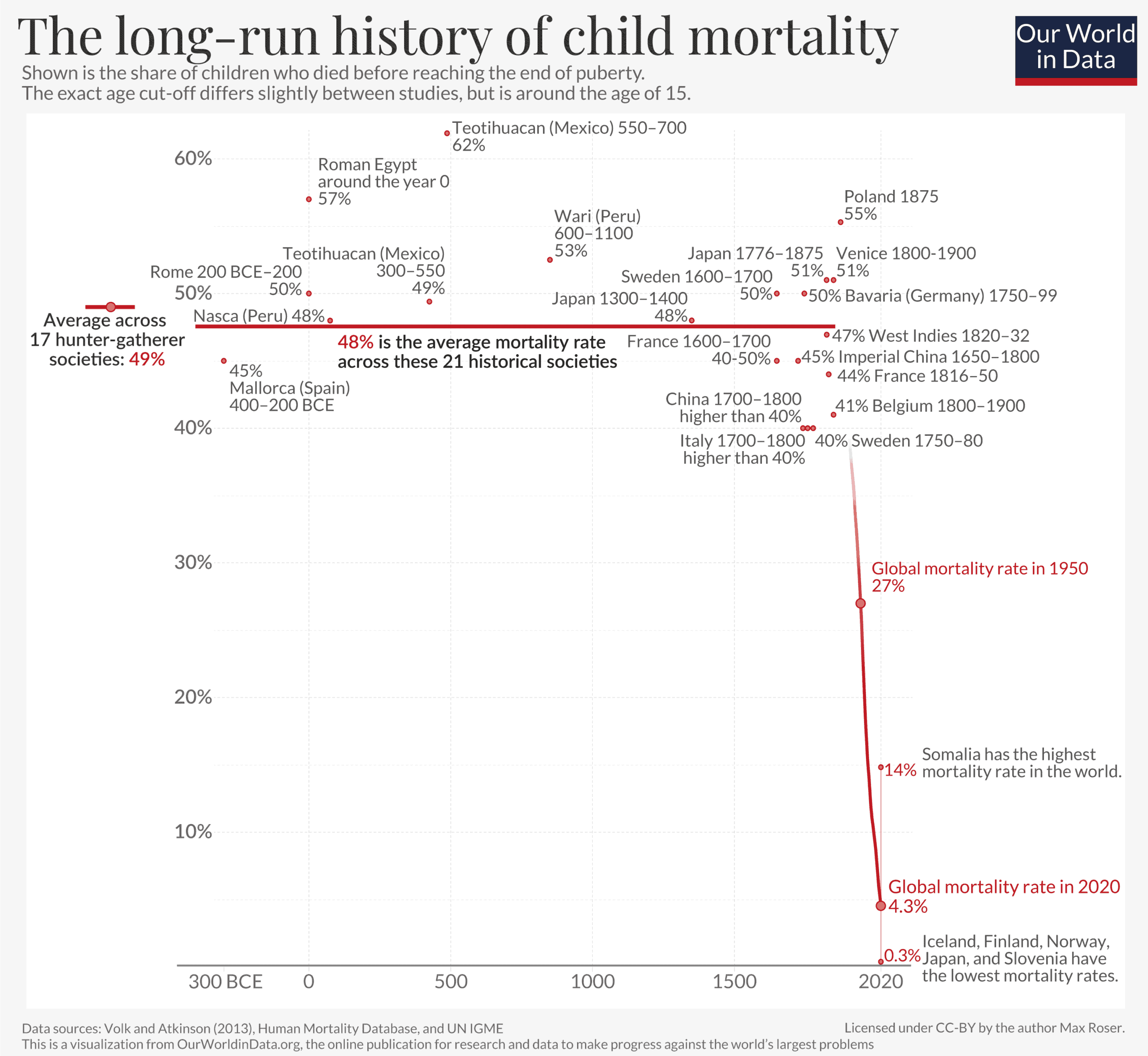
It’s horrific to imagine a world where nearly half of all children died before puberty. But this was our world until rather recently.
Unfortunately, life is a great filter. Once you realize this, it’s easy to see how precious every individual is. Because every one of us had to get through that filter to get here.
This wasn’t apparent to me until I experienced pregnancy and childbirth firsthand. I’ve always conceptualized why children are important, but now I can feel why they are. I now understand the time, the energy, the worry, and the hope it took to get here. And not just my own. But that of my parents, and their parents, and their parents, and so forth.
I have no clue what financial investments my great-grandparents made, if any. But I know they invested to raise my grandparents. And my grandparents did this for my parents, who, in turn, did this for me. Your ancestors did the same for you as well.
I’ve spent nearly a decade writing about investing and it was only a few weeks ago that I got a deeper understanding of what that word really means. Yes, your investments involve what you do with your money, but also how you spend your time.
Every parent who loses sleep to feed their child or works a job in order to provide is investing too. They’re investing in a better future for their children. This kind of investing doesn’t show up on a balance sheet, but it’s arguably even more important than the kind that does. Because without such investments, the world as we know it would cease to exist.
I know this now and have already seen a change in how I spend my time. Having a newborn brings such immense clarity over your day. It focuses you in a way that nothing else can.
Because I am no longer investing solely for myself. I’m investing for my daughter and the generations to come. I’m investing to help them get through the great filter.
To all the mothers investing in their children, Happy Mother’s Day and thank you for reading.
This article was originally published at: https://ofdollarsanddata.com/the-great-filter/
Having a child gave me uber clarity on money: “I’m responsible for providing for this child.”
This strips away all the nonsense. A simple example: “should I buy this luxury car or make sure my child can go to college?”
Life gets hard when you have a child, but easier, too (and far more fulfilling).
Congratulations to you and your wife, Nick!
Congrats! and just keep buying (for your daughter)!